
Project Management is a Valued Skill
Project Managers are professionals whose job is to plan, coordinate and execute projects or companies’ objectives successfully and within a specific timeframe and budget. You can become a Project Manager by getting a degree in project management or transferring in from other fields.
The importance of project management in any organisation cannot be over-emphasised.
Once implemented, an effective project management methodology helps companies’ operations run more smoothly, keeps teams and workers focused, and empowers them to deliver results faster.
We’ve put together an extensive guide that can help you start your career as a Project Manager. Read on to find out what skills and certifications you need to become a Project Manager.
What is a Project Manager?
A Project Manager is in charge of planning, procurement, and managing people and resources for the execution and completion of a project.
They are responsible for the entire project scope, the project team, resources, budget, project timeline, and the success or failure of the project contracted to them to execute.
The Project Manager role is needed in just about every business sector, such as the construction industry, manufacturing, or marketing.
According to a consultancy firm Bain & Company report, most work will be project-based by 2027.
This report also confirms the Project Management Institute's (PMI) prediction that says “demand for Project Managers is growing faster than demand for other skilled workers.”
Let’s take a detailed look at what Project Managers do and how you can become a Project Manager.
What Does a Project Manager Do?
A Project Manager's job description involves the daily management of people, time, money, and materials needed to execute a company's objectives successfully.
Here are some of the tasks and duties of a Project Manager:
Tasks and Duties
- Control all project management phases
- Develop a comprehensive project management design to track project progress
- Manage and track various projects through an entire project lifecycle
- Plan out the tasks that need to be done, who is going to do them along with a timeline of project delivery
- Lead and ensure team members' motivation and effectiveness on the job;
- Develop professional business relationships
- Report how the project is progressing with stakeholders
- Detect, evaluate, and manage any risks that may hinder the successful execution and completion of a project
- Track work hours and maintain accurate day-to-day timesheets
- Organise workshops and training
- Manage projects through KPIs
- Appraise team performance
- Review and report project results and give insights into how it was managed and executed
- Make recommendations for future improvements
Skills and Attributes
Success in project management will require you to be great at two different but complementary skill sets. The first is what we call technical skills, and the second is centred on behavioural skills or soft skills.
Most repetitive or physical tasks require applying technical skills to solve them. They can be easily managed today using project management tools, which are becoming more sophisticated all the time.
However, while technology helps Project Managers, this role is ever-changing and requires Project Managers to be skilled in behavioural management.
These people skills are so critical in today’s workplace and include the ability to communicate, influence, and lead.
How to Become a Project Manager
There are two paths that you can take if you want to become a Project Manager. You can either get a degree in project management principles then take a role as a Project Manager after graduating, or switch from seemingly unrelated fields after learning the appropriate skills while on the job.
Whichever path you decide to take, here are six steps you should consider to become a Project Manager:
- Understand what project management skills you may already have
- Build project management experience
- Develop project management skills
- Enhance your Project Manager resume
- Look for entry-level positions
- Consider a project management credential
1. Decide if Project Management is Right for You
A project management career means you will be an essential part of all critical new initiatives at your firm.
If you are a goal-oriented person, a confident communicator, an excellent manager of risk, and have a deep interest in leading a group of people toward the success of a business objective, then project management will be a great career path for you.
However, you must consider three important factors that can help you determine if it is a career path to take: career path, salary, and employment outlook.
But first, let's talk about Project Managers’ working hours.
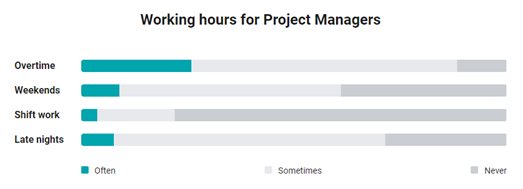
Typically the working hours of Project Managers are between 45 to 50 hours per week.
Project Managers working hours may be hard to determine as they usually don’t have a fixed, predictable timetable. Working hours depend on the type of organisation, project size, and the phase the project is in.
As a Project Manager, you are in charge of completing your organisation's objectives, so your day-to-day schedule will be highly unpredictable.
2. Get a Certificate, Diploma, or Degree
If you plan to start a career as a Project Manager, you need to get an education or Project Manager qualifications.
Having a degree is not a compulsory requirement. Still, a bachelor’s degree in business, computer science, or an MBA can help you develop the leadership skills you’ll need in this career.
Are you a young college graduate with a degree not related to project management, or are you a working professional looking to make a career switch into project management from an unrelated field?
Having a professional project management certification could help boost your resume and make you more appealing to hiring managers.
If you plan to get started in project management, you may like to acquire a relevant qualification.
3. Master Specific Skills
Project Managers are among the most sought-after professionals in the modern corporate world.
However, if you are to become a Project Manager, there are skills that you must master, such as critical thinking, budgeting, risk management, and negotiation skills.
You need to understand how project methodologies such as agile project management work.
While every team and project objectives are different, being skilled in project management software such as Microsoft Project could help you manage your projects efficiently.
Microsoft Project is a popular management software that is part of the larger suite of Microsoft Office products and is used by Project Managers all over the world.
A good reason why it’s been so popular is that Project Managers and team members were used to other Microsoft Office products such as MS Word, MS Excel, etc.
Project Managers use Microsoft Project to create project plans and schedules, manage resources, and keep track of time.
With features such as project calendars, Gantt charts, and Kanban boards, project management professionals can communicate, collaborate, report, track programs, project portfolios, and manage resources by requesting and assigning tasks easily.
Career path
The Project Manager career path offers opportunities for career growth in just about any industry you can think of. Some companies have a well-outlined growth projection for Project Managers, while in others, the career path for Project Managers is quite informal.
Jobs
The table below shows the Jobs available for PMs:
| Career Level | Tasks |
| Project coordinator |
Assists with administrative tasks for specific projects |
| Project Manager I |
Coordinates small projects works under the Senior PM |
| Project Manager II |
Coordinates one large project or a group of smaller projects |
| Project Manager III | Manages multiple or high-priority projects |
| Senior Project Manager |
Leads multiple project teams or programs |
| Program Manager |
Supervises a group of related projects to deliver results that benefits the organisation |
| Portfolio Manager |
Coordinates an organisation’s group of projects and programs |
Salary
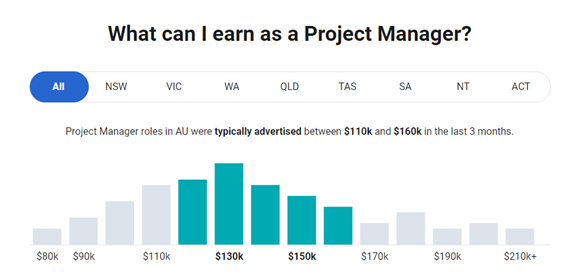
Talent.com Australia states that the Project Manager's annual salary is $123,365. Most entry positions earn $104,490, while most experienced workers earn up to $159,991 annually.
Industries like construction, consulting, pharmaceuticals, aerospace, and food and beverage seem to offer the most compensation for Project Managers.
Outlook
When making a career choice, one fact to consider is its employment outlook.
You will spend about 30 to 40 years of your life working, so you want to make sure that you choose a career path with lots of opportunities.
According to a PMI report, “organisations will employ nearly 88 million persons in project management-related roles by 2027.”
The report also reveals that professionals seeking to build a project management career in industries such as manufacturing, construction project management, finance and insurance, information services and publishing, health care, management, and professional services are expected to see the most significant growth in project-oriented roles.
Related careers
The skills that Project Managers have developed over the years usually open up new opportunities for them.
They can generally transfer these skills into other management positions within several industries.
Possible related careers for Project Managers looking to make a job change include general manager, account manager, business developer, consultant, program manager, director of operations, chief executive officer, etc.
FAQs / Resources
Is it hard to become a Project Manager?
It certainly is not easy. You need the right education and/or certification, which involves years of study, and the right skill sets to become a Project Manager.
It can be a tough job and you have to be the right person to handle all the responsibilities of managing a project.
How long does it take to become a Project Manager?
It depends on the educational background and management experience that you could have. However, it can take between three months to a few years.
How to get a Project Manager job with no experience
You may be able to work as a Project Manager even if you have no experience. As long as you can demonstrate that you have built skills that a Project Manager should have through previous job roles.
How to become a Project Manager without a degree
You can explore our Microsoft Project courses and get a project management certificate to get started on your project management career, even if you do not have a tertiary degree.
What is the cost of becoming a Project Manager?
A project management training program usually costs between $500 and $2,000.
Is being a Project Manager a stressful job?
As a Project Manager, your job can be stressful. You are responsible for on-time delivery of projects. In many cases, you will be working with limited resources, a fully booked to-do list, and clients’ unrealistic expectations.
Enhance Your Skills Today
To jumpstart your career as a Project Manager, you can check our Microsoft Project training courses to streamline your daily managerial task with this highly efficient tool. We have Beginner, Intermediate, and Advanced levels for you to choose from depending on your experience and proficiency.