Teaching is a job that comes with great responsibility. It is not only about imparting knowledge but also inspiring and making a difference in every student's life you encounter.
Do you want to take on this role? You may be thinking about how to become a primary teacher or a high school teacher. Regardless of the specific age group of students, there are qualifications for teaching in Australia.
Generally, teachers need to complete a bachelor's degree, postgraduate studies, and registration in different states in Australia. However, these are not the only requirements for teaching.
This article will thoroughly discuss how to become a teacher in Australia. We will also tackle the skills and attributes of a teacher, the types of teachers, the job requirements, career paths, and salaries.
Let's jump in!
What are the Requirements to be a Teacher?
Skills and Attributes
Aspiring teachers need to have these skills and attributes to teach:
- Patience
- Understanding
- Empathy
- Good communication skills
- Leadership
- Knowledgeable
- Organizational skills
- Dedication to helping students
- Enthusiastic and approachable
- Technical skills
Don't worry about not having these skills now because you can develop them through training. For instance, you can avail yourself of Nexacu's Microsoft Office courses to develop the technical skills you will need to prepare and discuss your topics.
Types of Teachers
There are three types of teachers that teach at three different levels. The types are Early Childhood teachers, Primary School teachers, and Secondary School teachers. These teachers have different qualifications, duties, and responsibilities.
Preschool/ Kindergarten School Teacher
A Preschool or Kindergarten School Teacher focuses on teaching pre-primary school students. They not only teach and prepare them for classes but also help build young children's confidence through various engaging activities, such as art, play, and drama.
Preschool teachers assess, track, and report each child's growth and interact with their parents. Aside from the parents, they may also work with experts, such as speech pathologists and child psychologists, when necessary.
Overall, they foster children's self-expression, sense of individuality, and interest in learning.
Qualifications
- Educational Requirements
To work as a preschool teacher in Australia, you must meet the essential educational qualification. You can take a four-year Bachelor of Early Childhood Education or Bachelor of Early Childhood and Primary Education.
However, if you have a degree with a different specialty, you can take a postgraduate degree specializing in Early Childhood Education.
The Australian Children's Education and Care Quality Authority (ACECQA) will also recognize you as an "equivalent childhood teacher" if you have either a primary or secondary teaching qualification.
- Certifications and Diploma
Before graduation, the government requires all Australian students taking an education or teaching qualification program to take and complete the national Literacy and Numeracy Test for Initial Teacher Education Students.
It is also a requirement to have an approved diploma level qualification in education, a Working with Children Check, a comprehensive First Aid certificate, and an approved certificate III level or higher for Early Childhood Education and care qualification approved by the ACECQA.
- Registration
Once you complete your teaching qualification, you must complete teacher registration or accreditation in the state you want to teach.
Primary School Teacher
A primary school teacher teaches children from Kindergarten through Year 6. These children are usually aged between five and 12.
With the government-mandated curriculum, primary school teachers help children improve their literacy and numeracy skills. They use various techniques and technologies to create activities and lessons that fit the children's age, ability, and individual requirements.
Primary school teachers also prepare children for high school education by helping them foster their social and emotional development.
Like preschool teachers, primary school teachers also assess and evaluate the children's development. They relay and update the information regularly to the school administrators and parents.
Qualifications
Here are the qualifications to become a primary school teacher:
- Educational Requirements
To become a primary school teacher, you must complete a teaching degree, such as a Bachelor of Education major in Primary Education.
If you have a different undergraduate unrelated to teaching, you must finish a postgraduate study in teaching, such as a Master of Teaching for Primary Education.
Aside from earning a degree in teaching, you also have to have a one-year of full-time studying in any key learning areas. These key learning areas are English, Mathematics, Science and Technology, Personal Development, Health and Physical Education, Human Society and its Environment, and Creative Arts and Practical Arts.
- Certificates and Diploma
There are other certifications and additional qualifications you must comply with. These include completing the CASPer test, LANTITE test, Teaching Performance Assessment, and obtaining the Working with Children Check.
CASPer is a Computer-Based Assessment for Sampling Personal Characteristics and assesses how you handle challenging situations. It is one of Australia's first steps to becoming a teacher in primary school.
LANTITE stands for the Literacy and Numeracy Test for Initial Teacher Education Students. It is a requirement for all aspiring teachers to assess whether they have met the standard for literacy and numeracy skills.
Teaching Performance Assessment is an assessment that you take after completing placements. Its main goal is to ensure that you are already prepared as a teacher in a classroom setting.
Primary teachers need to obtain a Working with Children Check like preschool teachers. It is a screening process that ensures that you meet the requirements of the Worker Screening Act 2020.
- Registration
After you have completed your educational requirements and complied with other qualifications, you now have to apply for registration as a teacher in Australia.
All primary school teachers must register because it guarantees qualifications and commitment to professional development.
Secondary School Teacher
Secondary School teachers focus on teaching students who are between the ages of 7 to 12, typically between 12 and 18. They are generally experts in their subject areas.
They typically have key areas of study, including science, mathematics, technological and applied sciences, human society and its environment, English, languages, personal development, creative and performing arts, and health and physical education.
They ensure that they are up-to-date with the current developments in their subjects, which include teaching resources, curriculum changes, and teaching methods.
Secondary school teachers also use different tools and technologies in teaching. They also need to know how to use computers and other necessary and relevant equipment in teaching.
If you have trouble self-learning using different teaching tools, you can check out various courses that Nexacu offers. They can train you to acquire the skill you want to learn.
Qualifications
- Educational Requirements
Completing an undergraduate degree in secondary education is necessary to become a secondary school teacher. Another alternative is completing a degree and taking a postgraduate course, such as a Master of Teaching focusing on Secondary.
- Certificates and Diploma
Like preschool and primary school teachers, secondary school teachers also need a Working with Children Check from the Department of Communities.
They also have to have a National Police History Check (NPHC), which the Department of Education Screening Unit will do.
They must also take the Literacy and Numeracy Test for Initial Teacher Education Students before graduation to assess their literacy and numeracy schools.
- Registration
Lastly, you must register with the Teacher Registration Authority in the state or territory where you will work. This is needed to check your qualifications and commitment to teaching.
How to Become a Teacher
There are two ways to begin your career as a teacher in Australia. One is to complete a teaching degree. However, qualifications to become an early childhood, primary school teacher, and secondary school teacher may differ based on where you studied.
The other way is to complete an undergraduate degree in a discipline different from teaching, such as music or math. After that, you should finish a postgraduate teaching degree.
There are also other teaching qualifications depending on the state and the type of teacher you are aiming for. But one requirement for all aspiring Australian teachers is the LANTITE test before graduation.
After completing all the teaching qualifications, you must apply for teacher registration. Registration is done in your relevant state. Take note that you must maintain your registration throughout your teaching career.
Career path
Here is the overview of the career opportunities for teachers:
Jobs
Teaching is a large profession, and the Education sector is Australia's largest employing industry. With the growing population in the country and a high likely observing smaller class sizes, the demand for teachers is expected to grow.
However, job opportunities for teachers may vary by state. It may not be easy to land a permanent position, but there are numerous schools and educational institutions that still make teaching a good career choice.
Salary
The salary of teachers may vary by location and work experience.
According to Labor Market Insights, the average weekly earnings of people who work in the Education and Training industry amount to AU$1250.
Payscale provides details on the salary of teachers in Australia. But we will only present the salary of preschool, primary, and secondary teachers.
The average base salary of primary school teachers is AU$64,491. The exact salary will differ depending on the year of experience. You can see the graph below for reference.
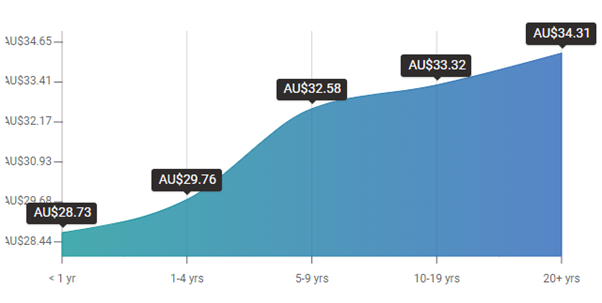
Photo source: Payscale
Primary schools, on the other hand, earn AU$ 71,009. But the graph below shows that entry-level teachers with less than one year of experience are paid AU$28.73/hr, including all the bonuses and overtime pay.
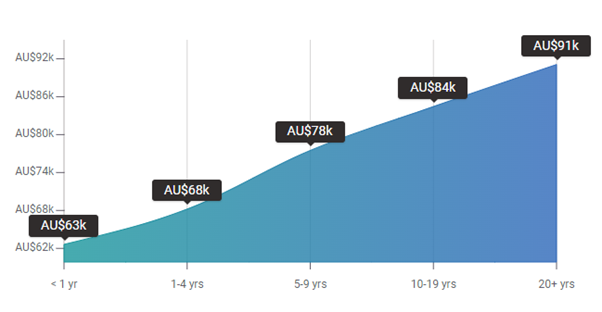
Photo source: Payscale
For secondary teachers, the average pay is AU$74.020. Check the graph below for differences in salary according to years of experience.
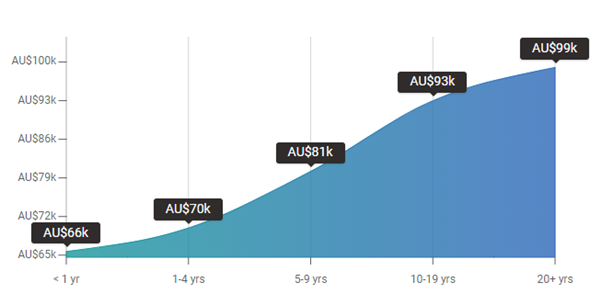
Photo source: Payscale
Meanwhile, the Government of Western Australia boasts of giving the highest salaries to teachers in Australia. Their starting salary is $72,137 for teachers with four years of training. There is also an annual increment if teachers perform satisfactorily.
Outlook
The Education and Training industry, where School Education is the largest sector, is expected to grow by 13.4% and reach 149,600 by November 2026.
Specifically, the National Skills Commission say that the number of Early Childhood Teachers is expected to grow by 21.6% and is likely to reach 59,900 by 2026.
Primary School Teachers are likely to have a moderate growth of 5.1% and increase to 157,300 in 2026. Likewise, Secondary School Teacher numbers are also expected to grow moderately, by 3.7%, with a 160,000 increase in the number of workers by 2026.
Related Careers
There are also related careers in the Education sector. We presented it in a table that shows the top 10 related careers based on ANZSCO Skill Level 1, which is the highest level. The list includes careers with a large share of employment and a large percentage of workers in the industry based on the 2016 ABS Census.
| ANZSCO Code | Occupation | Employment in all industries | Employed in this industry | Percentage of employed in this industry |
|
2412 |
Primary School Teacher |
148, 172 |
145,960 |
99% |
|
2414 |
Secondary School Teacher |
137,085 |
137,085 |
99% |
|
242111 |
University Lecturer |
37,210 |
36,762 |
99% |
|
2422 |
Vocational Education Teacher |
30,536 |
24,412 |
80% |
|
1343 |
School Principal |
20,600 |
20,240 |
98% |
|
2411 |
Early Childhood (Pre-primary School) Teacher |
26,986 |
18,822 |
70% |
|
241511 |
Special Needs Teacher |
17,977 |
17,115 |
95% |
|
242112 |
University Tutor |
11,009 |
10,869 |
99% |
|
249214 |
Music Teacher (Private Teacher) |
10,893 |
10,455 |
96% |
|
249299 |
Private Tutor and Teachers |
11,177 |
9,936 |
89% |
Source: Labor Market Insights
FAQs / Resources
Is it hard to become a teacher?
The NEiTA-ACE TEachers Report Card 2021 found through a survey conducted last 2021 that Australian teachers still see the teaching profession as satisfying and rewarding.
How to become a QLD teacher?
The first step to becoming a QLD teacher is enrolling and getting a degree in an approved initial teacher education program. You must also obtain a teaching qualification and registration with the Queensland College of Teachers (QCT). Lastly, you must comply with all the mandatory requirements to be eligible to teach.
Once you are eligible to teach, you can submit your application form to the applicant center and search to apply for vacancies.
How long does it take to become a teacher in Australia?
The minimum qualification for becoming a teacher in Australia is a bachelor's degree, which takes up to four years. If you take a bachelor's degree and a postgraduate degree in teaching, it may take approximately six years to become a teacher.
Improving Education with Technology
Being a teacher entails a long shopping list of daily tasks and routines that requires streamlining for efficiency. Since students depend primarily on their teachers, it's best for them to undergo training for essential skillset such as visualising through Power BI from the Beginner to Certification level.