
Say you’ve been on the job hunt for the past couple of months. You have finally found your dream job and are very excited to get started. But before you move on to this new job, you need to resign from your current one.
So how do you write a resignation letter? A great resignation letter officially informs your current boss that you are leaving and ensures that you leave on good terms. However, there are more technicalities that you need to remember when writing this formal correspondence.
Read on as we explain how to write a clear and concise one that lays down all the necessary details.
Why It is Important to Write a Resignation Letter
When you are in a job and find another, writing a resignation letter is essential because of the following reasons:
- It serves as formal documentation. The resignation letter lets you officially inform your boss of your intention to leave your current job.
- It helps you communicate the details of your exit. The resignation letter allows you to communicate your intended last day at work so that the reasons for your departure are clear to your current employer.
- It ensures compliance. Most organisations require that employees give them some weeks (usually two) notice when moving on. The resignation letter provides evidence of your compliance with such requirements.
- It helps you leave on a good note. The resignation letter could be the difference between leaving on good terms or not. It is an opportunity to officially thank your employer and the organization for the opportunity to work with them. You may also show that the organization has impacted you professionally or personally by sharing something you learned while with them.
How Much Notice Do I Need to Give?
How much notice you need to give when resigning depends on whether or not you have an employment contract and what your employment contract states.
- No employment contract. If an award or agreement does not cover your employment, you are not legally required to give any notice when resigning.
- An employment contract exists, and it has clear terms. If you are an employee covered by an award or agreement, you need to give notice in accordance with the terms of the award/ agreement.
- An employment contract exists, but it is silent on notice. Where the agreement is silent about the length of notice, you may give “reasonable” notice. Interestingly, career experts have posited that two (2) weeks is reasonable notice. So, two weeks has become the standard.
How to Write a Resignation Letter
Recently, a unique resignation letter broke the internet. It read “Bye-bye, Sir.” Not surprisingly, this is not the way to write a resignation letter if you want to leave on a good note and maintain professional contacts.
So, how do you write a resignation letter? Surely, you should not copy the three-worded resignation letter, but you should also not give excessive details. Importantly, the language should be official, and the tone should be respectable.
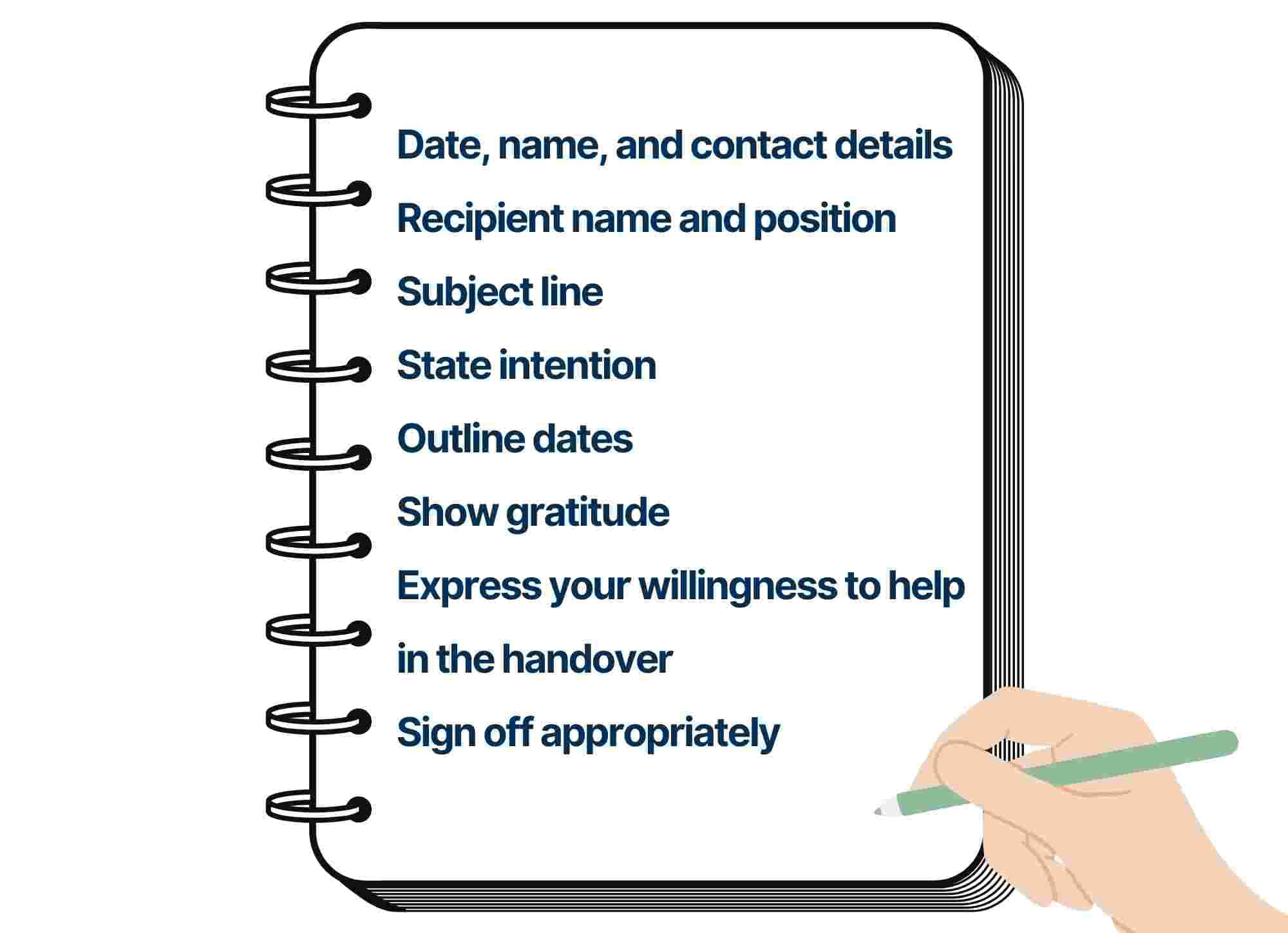
Moreover, use an official letter format. In the letter, clearly state your intention to resign and your last day of work, express gratitude for the opportunity the company gave you and a willingness to assist in the handover, and then sign off appropriately.
Your resignation letter should include the following information:
Date, Name, and Contact Details
Like every formal letter, your resignation letter should start with the date. This should be followed by your name and contact details (phone number and email address).
Recipient’s Name and Organisational Position
You should address the resignation letter to the right person. Depending on your organisation, that would be your current line manager or the head of the human resource department. State the recipient’s name and title, followed by the company's name.
You should follow the recipient's details with an official greeting, such as “Dear, [the recipient’s first name].”
Subject Line
The subject line is a feature of formal letters. It lets the recipient know what the letter is about. Thus, your subject line should clearly state that you are resigning (e.g. “Letter of Resignation”).
State Intention
The opening statement of your letter should clearly state that you are resigning. You need not go into the nitty gritty just yet.
Outline Dates
After concisely stating that you want to resign, outline the key dates relating to your resignation, namely the last day you’ll be at work. If your contract requires a particular notice period, ensure that you comply with this.
Show Gratitude
Thank your employer for the opportunity to have worked in your position. Mention one or two special moments you are grateful for in the organization. Share how the organization has positively impacted you personally and professionally.
Express your Willingness to Help in the Handover
State that you are willing to help in any way required so that systems continue to operate smoothly.
Sign Off Appropriately
An official and respectful sign-off is “Sincerely,” followed by your signature and name.
Resignation Letter Template
Below is a template that you can use when writing your resignation letter.
|
Date Name Contact Details
Dear [recipient’s first name], Please accept this letter as notice of my resignation from my role as [your job title] at [the organization’s name]. I hereby give you [notice period] notice of my departure, as my last day of employment will be [your intended date of stopping work]. Thank you for the opportunity to work with you over the last [your duration in the company] years. One of the highlights of my career is [a successful company project]. I wish you success in the upcoming [a current company project]. I am eager to make this transition smooth, so please let me know if there is anything I can do during this time. Thank you again for the opportunity to work for [company’s name]. I wish you all the best in the coming years. Sincerely, [your signature] [your full name] |
What Not to Include in A Resignation Letter
You should not include some things in your resignation letter because including them may come back to bite you. You may need a reference letter from your current employers, or you may be in a field where key players are well-connected.
That said, some of the things you should not include in a resignation letter are:
- A detailed explanation of why you’re leaving
- Negative comments about your boss or the company
- Reasons you hated your job
- Criticism of your colleagues
- Your future plans (such as your career plans)
- Personal emotional sentiments
- Inappropriate language
- Threats of retribution
FAQs/ Resources
Here are the most frequently asked questions about writing a resignation letter:
Should I say where I am going when I resign?
What to include in a resignation letter does not include your future plans. Thus, you do not have to tell your current employer where you are going.
The only exception is when you have signed a non-compete agreement that prevents you from moving from the company to a direct competitor.
How can I resign gracefully?
You can resign gracefully from your work by doing the following:
- Write and submit an official letter of resignation. You may use the resignation letter template above.
- Be positive. Leave grievances (or negative reasons for wanting to leave) out of the resignation letter.
- Give your best during the notice period. Don’t switch off mentally because you are leaving. Instead, work as you have always done in your notice period and ensure you complete assignments and reports.
Important Read: Career Advice You Need To Hear
What Now?
After sending your resignation, you might feel the need to look for new job opportunities immediately. Get the attention of top employers by enroling in our Microsoft Project training course that starts from Beginner to Advanced. This will help you stand out in the competitive job market today and land your dream job as soon as possible.